


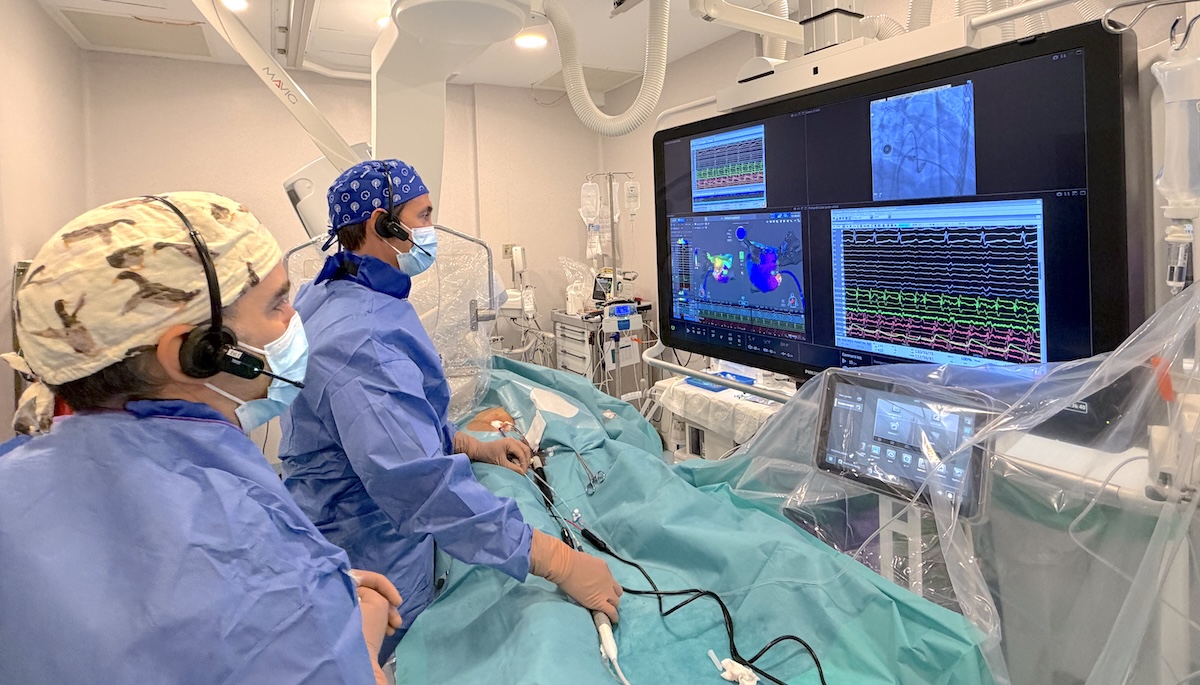
The Arrhythmia Unit at La Luz University Hospital has begun performing procedures with the Affera™ platform and the Sphere-9™ catheter, which allow the specialist to map the heart and perform ablations with pulsed field or radiofrequency technology with the same device during the intervention.
Palpitations, a feeling of irregular heartbeat, fatigue, shortness of breath, or dizziness can be some of the symptoms of atrial fibrillation , the most common cardiac arrhythmia. In Spain, it is estimated to affect more than one million people, and its prevalence increases considerably with age.
When ablation is indicated, the goal is to target the areas of the heart involved in the origin or maintenance of the arrhythmia. To do this, electrophysiologists insert catheters into the heart, usually through a vein in the groin, and locate the areas that need to be ablated.
New technology for the ablation of atrial fibrillation at La Luz Hospital
The La Luz University Hospital, part of the Quirónsalud Group, has incorporated advanced technology for the ablation of atrial fibrillation and other complex atrial and ventricular arrhythmias . The Affera™ platform and the Sphere-9™ catheter allow specialists to map the heart and apply pulsed fields or radiofrequency ablation with a single device during the procedure.
Thus, the Arrhythmia Unit of the Madrid center becomes one of the pioneering centers in Spain to use this platform for the treatment of this type of arrhythmia.
Dr. Juan Benezet, head of the Arrhythmia and Electrophysiology Unit at the Comprehensive Cardiology Unit of the La Luz University Hospital, explains one of the main advantages of this technology: “We can map the heart and use two different energy sources in the same catheter to perform the ablation. This gives us greater safety and versatility to decide how to target each area during the procedure itself and adapt the strategy to the characteristics of each patient.”
What is pulsed field ablation?
Traditionally, atrial fibrillation ablation has been performed primarily using techniques that employ heat, such as radiofrequency ablation, or cold, such as cryoablation, to generate controlled lesions on the cardiac tissue involved in the arrhythmia.
In recent years, pulsed-field ablation (PFA) has been incorporated. Unlike thermal techniques, it uses very short, high-intensity electrical pulses to act on the cells of the selected cardiac tissue.
“Pulsed field therapy has brought about a significant change in electrophysiology because it allows us to act very selectively on cardiac tissue. One of its particularly interesting characteristics is precisely its safety profile with respect to certain structures near the heart,” says the head of the Arrhythmia and Electrophysiology Unit.
The unique feature of the Sphere-9™ catheter is that it integrates electroanatomic mapping and pulsed-field and/or radiofrequency ablation capabilities into a single device. This allows the electrophysiologist to choose between these two energy sources without needing to replace the catheter during certain phases of the procedure.
“In an ablation, not all areas of the heart necessarily have the same characteristics or require exactly the same strategy. Being able to select the energy source while maintaining the same system allows us to further individualize the procedure,” adds Dr. Benezet.
More than one million people with atrial fibrillation .
Atrial fibrillation occurs when the electrical activity of the atria—the upper chambers of the heart—becomes disorganized and they stop contracting in a coordinated manner.
Some patients experience palpitations, fatigue, shortness of breath, dizziness, or decreased exercise tolerance, while others may have few symptoms or even be unaware that they have this arrhythmia.
Its importance goes beyond the discomfort it can cause. Atrial fibrillation is linked to an increased risk of stroke and heart failure, making its proper diagnosis and treatment essential.
“We shouldn’t focus solely on palpitations. Some patients consult us because they are becoming increasingly tired when performing activities they previously did without difficulty, while in other cases atrial fibrillation may be detected incidentally. That’s why it’s important to assess each situation individually,” Dr. Benezet points out.
Treatment depends on factors such as age, symptoms, duration of the arrhythmia, other cardiovascular diseases, and the specific characteristics of each patient. It may include medication, measures to reduce the risk of blood clot formation, and, in selected patients, ablation procedures.
Ablation of atrial fibrillation customized during the procedure
The incorporation of systems capable of combining different technologies aims precisely to advance towards procedures that are increasingly adapted to each patient.
For Dr. Juan Benezet, the value of these kinds of advances should be measured primarily by their contribution to clinical practice: “Technology is truly useful when it allows us to treat the patient better. Having more information during mapping and being able to choose between different energy sources with the same tool gives us more possibilities to design the ablation strategy we consider most appropriate in each case.”
With this new advanced technology, the Arrhythmia and Electrophysiology Unit of the Comprehensive Cardiology Unit of the La Luz University Hospital incorporates into its clinical practice a tool that combines high-density cardiac mapping and two ablation modalities in the same catheter for the treatment of selected patients with fibrillation or complex atrial arrhythmias.