


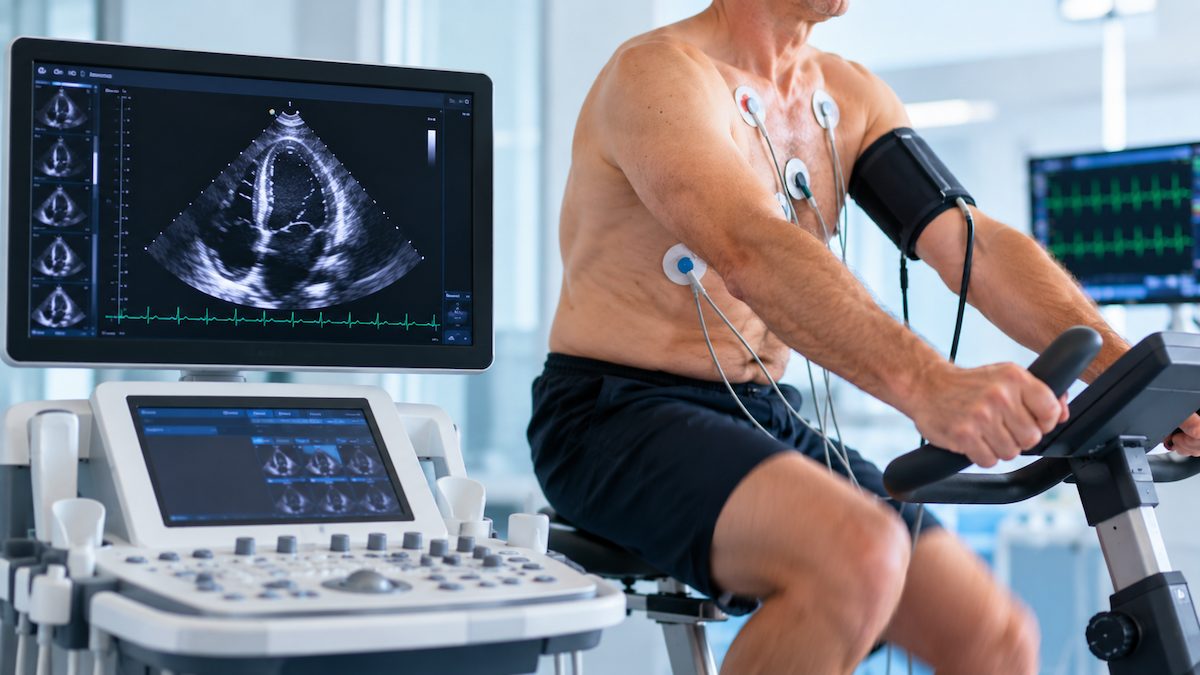
Dr. Patricia Barrio, a cardiologist at Quirónsalud Sur Hospital, explains what an exercise echocardiogram is, a test that allows us to study how the heart works when its workload increases and that can provide useful information for the diagnosis and monitoring of different cardiovascular diseases.
Many cardiac tests study heart function while the patient is at rest. However, some abnormalities may only appear when the heart needs to work harder.
The exercise echocardiogram , also known as the stress echocardiogram, allows us to observe precisely what happens during that effort and to compare the behavior of the heart at rest with its response to exercise.
What is an exercise echocardiogram?
An exercise echocardiogram combines a physical exercise test with an echocardiogram. Its purpose is to study how the heart functions at rest and how it responds when it has to work harder.
The test is performed using a stationary bicycle, which allows echocardiographic images of the heart to be obtained while the patient is exercising.
In this way, the cardiologist can analyze in real time how the heart responds to progressively greater exertion.
How is a stress echocardiogram performed?
The test is performed progressively and always adapted to the characteristics and possibilities of each patient.
First, a resting echocardiogram is performed to study the heart before starting exercise and to have a reference point for later comparison.
Next, the patient begins pedaling on a stationary bike. The resistance is gradually increased so that the heart works harder each time.
The goal is not to reach a certain speed or to participate in a competition, but to achieve an appropriate level of effort to obtain the necessary clinical information.
Throughout the test, the body's response is monitored using an electrocardiogram and blood pressure measurement, in addition to assessing any symptoms the patient may have.
At the same time, echocardiographic images are obtained during exercise and, especially, at the time of greatest exertion and during recovery.
In this way, it is possible to compare how the heart works at rest and how it responds when the demand for exercise increases.
What is the purpose of an exercise echocardiogram?
One of the main uses of exercise echocardiography is to study how the heart muscle responds when it needs to work harder and to detect possible signs that may indicate a decrease in blood supply to the heart during exertion.
For this reason, this test is frequently used in the diagnosis and monitoring of coronary artery disease or ischemic heart disease.
Coronary artery disease study
During exercise, the need for oxygen and blood flow to the heart muscle increases.
An echocardiogram allows us to observe how the heart moves and detect possible alterations in the movement of certain areas of the heart muscle that appear during exertion and that may be related to an insufficient blood supply.
Detection of heart rhythm disturbances
Throughout the test, the electrocardiogram is continuously recorded, allowing the detection of any heart rhythm disturbances or arrhythmias that may occur during exercise.
Assessment of blood pressure response
Blood pressure is also monitored during the different phases of the test, allowing us to know how it responds as the intensity of the exercise increases.
Study of heart valve diseases
In certain heart valve diseases , studying the heart during exercise can provide additional information to that obtained through an echocardiogram performed at rest.
Monitoring of patients with heart disease
In patients who already have coronary artery disease or another known heart condition , the results can help the cardiologist assess the progression of the disease and the response to treatment, as well as plan their follow-up.
How to prepare for an exercise echocardiogram?
It is recommended to wear comfortable clothing and footwear suitable for exercise, and to be able to pedal on a stationary bike.
The level of effort will be adapted at all times to the possibilities and clinical situation of each patient.
Before starting, it is important to inform the healthcare staff of any symptoms or health problems that may be relevant.
If the patient is taking cardiovascular medication, they should follow the instructions previously provided by their cardiologist on how to proceed before performing the test.
What is the difference between a stress test and an exercise echocardiogram?
Although both tests study the heart's response to exercise, the exercise echocardiogram also incorporates echocardiographic images of the heart.
This allows, in addition to recording the electrocardiogram, blood pressure and possible symptoms during exertion, observation of how the heart muscle moves and how its functioning changes when the workload increases.
Exercise echocardiogram: studying the heart during exertion
Exercise echocardiography allows the heart to be studied while it is working, not just when it is at rest.
The combination of exercise, electrocardiogram, blood pressure measurement, and echocardiographic images provides a more complete view of how the heart responds to exertion.
This information can be useful both for the diagnosis of certain cardiovascular diseases and for monitoring patients who already have a known heart condition.